Updated August 14, 2026 I 8 Min Read
Before you add a chatbot to your website, it helps to see the pros and cons of chatbots laid out honestly, without the usual sales spin. A chatbot can capture leads around the clock and take routine work off a small team, but a poorly built one can also frustrate customers and dent a young brand’s reputation. This guide weighs both sides so a growing business can make the call with clear eyes.
Quick answer: The main pros of chatbots for growing businesses are instant 24/7 responses, lower cost per conversation, and automatic lead capture. The main cons are customer distrust of AI, the risk of wrong answers, and weak handling of complex issues. Most cons come from poor setup rather than the technology itself.
Table of Contents
What are the pros and cons of chatbots?
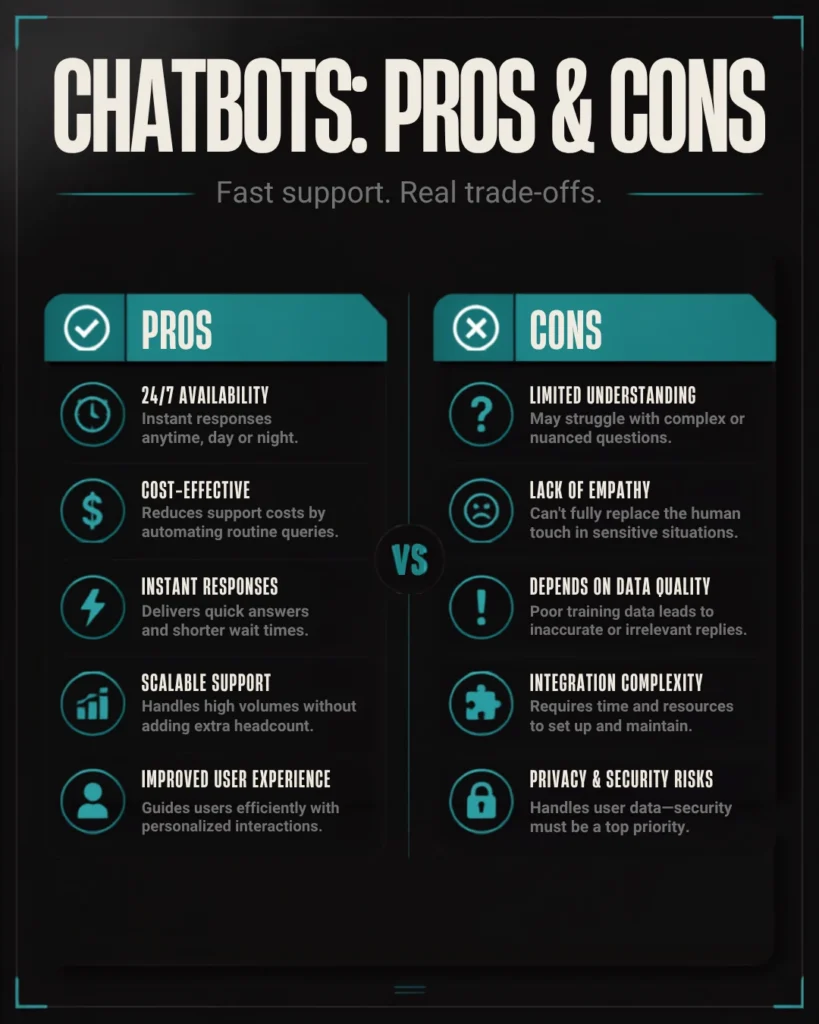
Chatbots give a growing business speed, availability, and scale at a low cost, which is the upside. The downside is that some customers dislike AI service, bots can give inaccurate or off-brand answers when trained poorly, and they struggle with complex or emotional issues. The right build captures the pros while limiting the cons through good training and easy human handoff.
Here is the short version side by side before we get into detail.
The pros of chatbots for growing businesses
For a company that is still small but growing, the advantages tend to hit exactly where the pain is: limited staff, tight budgets, and traffic that does not keep office hours.
Instant response that captures leads you would otherwise lose. Speed is the biggest one. A chatbot answers in seconds, at any hour, so the visitor who shows up at 10 p.m. gets help instead of leaving for a competitor. Missed and slow responses are one of the quietest ways a growing business loses revenue it already paid to attract.
Higher productivity and lower cost, without adding headcount. A chatbot handles many conversations at once, which lets a small team punch above its weight. The evidence here is strong. In a field study of 5,179 customer support agents, economists Erik Brynjolfsson, Danielle Li, and Lindsey Raymond found that access to a generative AI assistant raised issues resolved per hour by about 14 percent, and that improvement reached 34 percent for the newest and least experienced staff. Their paper, Generative AI at Work, also found that customer sentiment improved and employee retention rose. For a growing business, that means more resolved conversations per dollar and faster ramp-up for new hires.
Automatic lead capture and qualification. A good chatbot does not just chat. It asks qualifying questions, logs the contact to your CRM, and books the meeting, so leads are organized and followed up instead of slipping through the cracks.
Consistency and volume handling. A chatbot answers the hundredth question of the day the same way it answered the first, and it does not get overwhelmed during a traffic spike or a product launch.
A knowledge equalizer for your team. The same research found that AI assistance spreads the habits of top performers to everyone else, helping newer staff perform closer to the level of veterans. For a business hiring and training quickly, that is a real edge.
The cons of chatbots for growing businesses
Now the honest other side. These are real, and ignoring them is how businesses end up with an expensive tool that annoys customers.
Many customers are wary of AI service. This is the big one. A Gartner survey of 5,728 customers found that 64 percent would prefer that companies did not use AI in customer service, and that 53 percent would consider switching to a competitor if they learned a company was using AI for service. You can read the findings in Gartner’s survey release. This caution is not limited to customer service either. Pew Research Center finds that about half of U.S. adults feel more concerned than excited about the growing use of AI in daily life, while only about one in ten feel more excited, a gap detailed in Pew’s findings on how Americans view AI. For a growing brand still earning trust, that skepticism is a risk worth taking seriously.
Bots can give wrong or off-brand answers. A chatbot that is poorly trained can state something inaccurate or reply in a tone that does not match your business. A wrong answer from a big company is a nuisance. From a small brand still building a reputation, it can cost a customer.
They struggle with complex or emotional situations. Chatbots handle common questions well, but they falter on unusual, high-stakes, or emotional issues. This is exactly where customers most want a person, and the top concern people raised in that same Gartner survey was that AI makes it harder to reach a human.
They are not set-and-forget. A chatbot needs real setup and ongoing tuning. If you launch it and walk away, its answers drift out of date and its quality slides. That upkeep is a genuine cost of ownership.
Bad implementation actively frustrates people. The chatbots everyone hates are the ones with dead-end menus and no visible way to reach a human. A clumsy build does more harm than no chatbot at all.
When do the pros outweigh the cons?
Here is the useful pattern to notice: almost every con above is about poor implementation, not the technology itself. Customers do not resist a chatbot that helps them quickly and hands them to a person the moment they need one. They resist the bot that traps them.
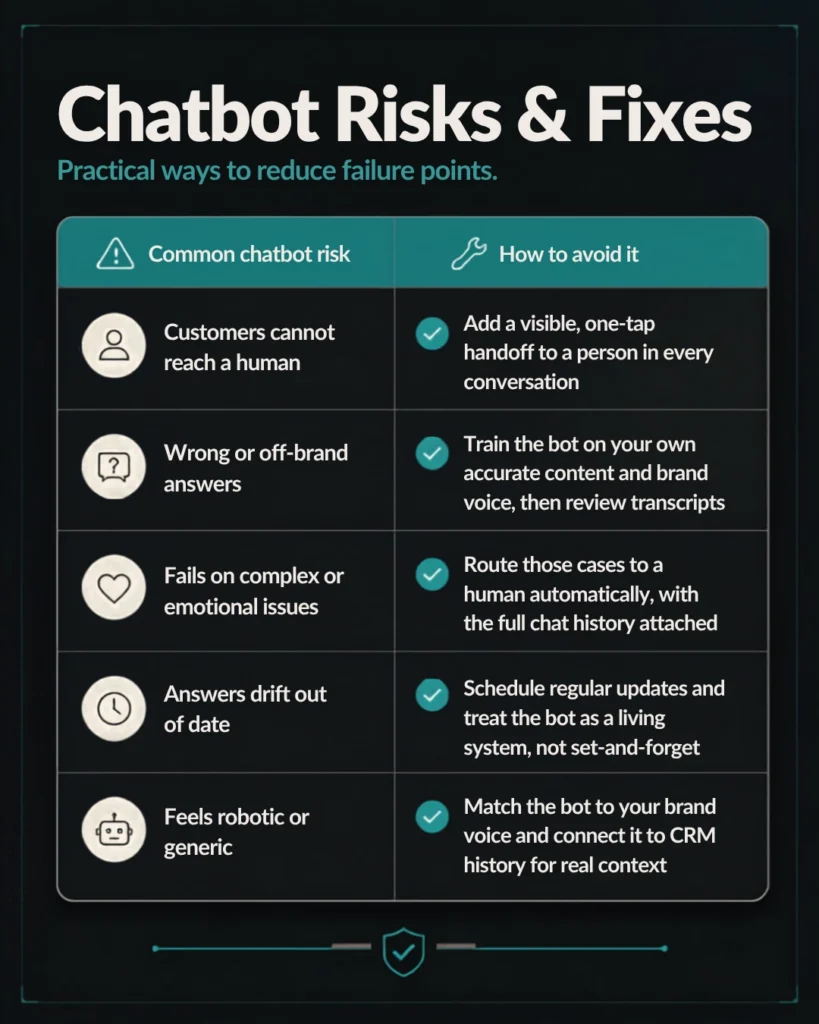
So the pros outweigh the cons when a growing business does a few things on purpose. Train the bot on your real content and brand voice so its answers are accurate and sound like you. Give every conversation an obvious, fast path to a human. Connect it to your CRM so leads are captured and context carries over on handoff. Then review the transcripts and keep improving it.
The table below maps each common risk to the specific fix that neutralizes it.
At Reisinger Strategies Group, this is exactly how we build. We help train each AI Sales Assistant on the specific brand’s voice and offers, wire it into the CRM, and set up clean human escalation, which is what turns the list of cons into non-issues while keeping every one of the pros. Done this way, a chatbot gives a growing business the speed and coverage of a much larger company without the payroll.
Pros and cons of chatbots: the verdict
Weighed fairly, the pros and cons of chatbots come down to how the bot is built and run. The upside for a growing business is real: instant 24/7 response, lower costs, and automatic lead capture. The downside is also real, but it is mostly avoidable, since customer frustration and wrong answers come from bad setup, not from chatbots as a category. Build it well, keep a human within easy reach, and the advantages clearly win for most growing companies.
Frequently asked questions
What are the main pros and cons of chatbots?
The main pros are instant 24/7 responses, lower cost per conversation, automatic lead capture, and consistency at scale. The main cons are that some customers distrust AI service, bots can give wrong or off-brand answers when trained poorly, they struggle with complex issues, and they need ongoing upkeep. Good implementation keeps the pros and limits the cons.
Are chatbots good for small or growing businesses?
Yes, when built well. Chatbots let a small team respond instantly around the clock and capture leads without hiring more staff, which is a strong fit for a growing business. The key is training the bot on your real content and offering an easy path to a human, so it helps customers rather than frustrating them.
What is the biggest disadvantage of chatbots?
The biggest disadvantage is customer distrust when AI is used poorly. A Gartner survey found 64 percent of customers would prefer companies did not use AI in service, largely because a bad bot makes it harder to reach a human. This is avoidable by keeping a clear, fast route to a person at all times.
Do customers actually like chatbots?
It depends on the experience. Customers appreciate chatbots for fast, simple answers and instant availability, but they dislike bots that trap them or give wrong information. Surveys show real caution about AI in service, so the businesses that win offer a helpful bot plus an easy handoff to a human agent.
How do I avoid the downsides of using a chatbot?
Train the bot on your accurate content and brand voice, connect it to your CRM, and give every chat an obvious way to reach a person. Then review conversations regularly and refine the answers. Most chatbot problems come from weak setup and neglect, so ongoing attention removes the majority of the risk.
Sources
- Brynjolfsson, E., Li, D., & Raymond, L. Generative AI at Work. NBER Working Paper 31161 (2023), later published in the Quarterly Journal of Economics (2025). Field study of 5,179 support agents: about 14% higher productivity overall, 34% for the least experienced, plus improved customer sentiment and retention.
- Gartner. Gartner Survey Finds 64% of Customers Would Prefer That Companies Didn’t Use AI For Customer Service. Survey of 5,728 customers, July 2024.
- Pew Research Center. Key findings about how Americans view artificial intelligence. About half of U.S. adults feel more concerned than excited about AI in daily life.

About the author
John Reisinger writes extensively on AI, SEO, automation, and the future of digital marketing — breaking down complex ideas into clear, actionable insights for business owners.
Stay Ahead of the AI Curve
Get weekly insights on how AI is reshaping marketing — from smarter automation to new growth opportunities. No noise, just signal.
Related reading: for the full overview, see our guide to the benefits of AI chatbots for business. To compare options, read chatbot vs live chat: which converts more leads, and for the road ahead see the future of chatbots in business.