Updated August 14, 2026 I 8 Min Read
Chatbot development cost is one of the first questions any business asks, and the honest answer is that it depends on what you are building. A simple website FAQ bot and a custom AI assistant wired into your CRM are both called chatbots, but they sit at opposite ends of the price range. This guide breaks down what businesses actually pay in 2026, what drives the price up or down, and how to budget without overspending or buying too little.
Quick answer: Chatbot development cost in 2026 varies widely by approach. A basic DIY chatbot can be free or cost a few hundred dollars a month. A capable AI chatbot platform runs roughly 100 to 1,000 dollars a month. A custom-built, brand-trained bot integrated with your systems typically costs 10,000 to 50,000 dollars or more to build, plus ongoing upkeep.
Table of Contents
How much does chatbot development cost?
Chatbot development cost falls into three broad tiers. DIY no-code tools are free to a few hundred dollars a month and suit simple FAQ bots. AI chatbot platforms run roughly 100 to 1,000 dollars a month for more capable, semi-custom bots. Custom-built AI chatbots, trained on your brand and integrated with your systems, typically cost 10,000 dollars or more to build plus ongoing maintenance.
The right number depends on how much the chatbot needs to do, how smart it needs to be, and how deeply it connects to your other systems. The table below shows the typical ranges businesses pay in 2026 for each approach.
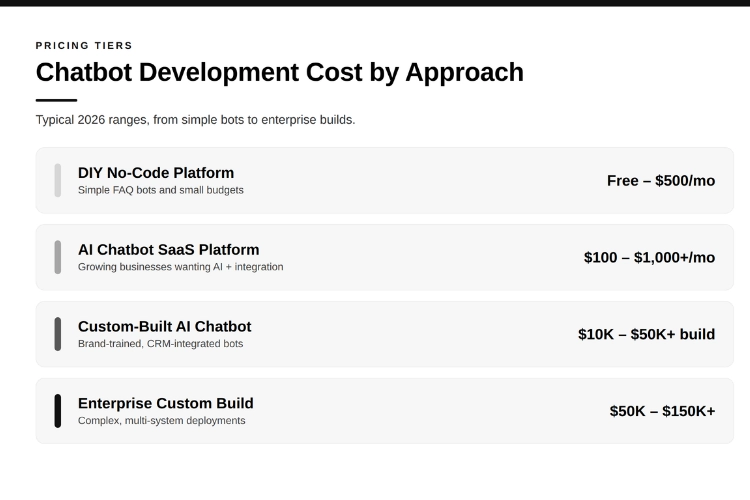
These are typical market ranges rather than fixed prices, and any given project can land above or below them depending on scope.
What drives chatbot development cost?
Custom development is priced mostly by the time of skilled people. In the United States, software developers earn a median of about 133,000 dollars a year, which works out to roughly 70 dollars an hour, according to the U.S. Bureau of Labor Statistics data on software developers. A custom chatbot that takes weeks or months of that time naturally lands in the tens of thousands of dollars, which is why the gap between a template bot and a bespoke build is so wide.
Beyond labor, a handful of factors move the price the most.
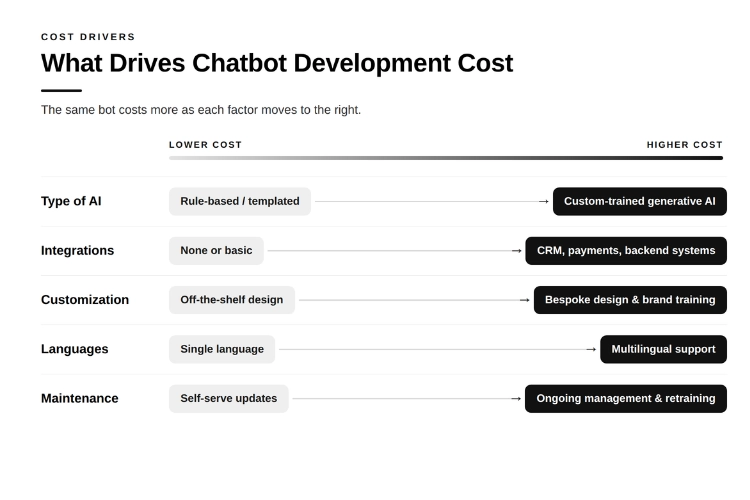
The pattern is simple. A bot that answers a short list of questions from a template is cheap. A bot that understands natural language, speaks in your brand voice, pulls live data from your CRM, and improves over time costs more because it takes more skilled work to build and maintain.
Custom build versus a monthly platform: which is cheaper?
In the short term, a monthly platform is almost always cheaper to start. You pay a subscription, configure the bot yourself, and go live quickly. A custom build costs more upfront because you are paying for design, development, and integration specific to your business.
Over a longer horizon, the math can shift. A platform subscription is a cost that never ends and often rises as you add usage or seats. A custom build is a larger one-time investment that you own, with lower ongoing costs. For a small business with simple needs, a platform usually wins. For a business where the chatbot is central to sales or support and needs deep integration, a custom build often pays off over a few years. The right answer depends on how important the chatbot is to how you operate.
Is a chatbot worth the cost?
The cost only makes sense against what the chatbot returns. The clearest way to see the return is to compare it to the work it offsets. A customer service representative in the United States earns a median of about 20.59 dollars an hour, or roughly 43,000 dollars a year before benefits, according to the Bureau of Labor Statistics data on customer service representatives. Add benefits and overhead and the real cost of a single support hire is higher still.
A chatbot that handles a large share of routine questions offsets a meaningful portion of that staffing cost, and it covers nights, weekends, and traffic spikes that no single employee can. On the sales side, the same bot captures and qualifies leads around the clock, so the return shows up as recovered revenue as well as saved labor. For most businesses, the question is not whether a chatbot is cheaper than a person, but how much work it can take off people so they focus on what actually needs them.
How to budget for a chatbot
Start with the job, not the tool. Decide what the chatbot must do, which systems it needs to connect to, and how much of your sales or support volume it should handle. That scope determines your tier. Do not pay for a custom enterprise build if a platform covers your needs, and do not force a cheap template bot to do work that requires real integration. Budget for ongoing costs too, since a chatbot needs maintenance and retraining to stay accurate, not just a one-time build.
At Reisinger Strategies Group, we scope each chatbot to what the business actually needs, which keeps clients from overpaying for capability they will not use or underinvesting in a bot that cannot do the job. We connect the chatbot to the CRM and train it on the brand, so the spend goes toward a tool that captures leads and handles service rather than a novelty that sits unused.
Chatbot development cost: the takeaway
Chatbot development cost in 2026 spans from free DIY tools to six-figure enterprise builds, and the right number comes down to scope. Simple FAQ bots are cheap, capable AI platforms run a few hundred to a thousand dollars a month, and custom, brand-trained, integrated bots start in the tens of thousands. Judge the price against what the chatbot offsets in staff time and captures in leads, budget for upkeep as well as the build, and match the tier to the job rather than paying for more or less than you need.
Frequently asked questions
How much does chatbot development cost in 2026?
It ranges widely by approach. A DIY no-code bot can be free or up to a few hundred dollars a month. An AI chatbot platform typically runs 100 to 1,000 dollars a month. A custom-built, brand-trained bot integrated with your systems usually costs 10,000 to 50,000 dollars or more to build, plus ongoing maintenance. Scope and complexity drive the final figure.
Why is custom chatbot development so expensive?
Custom development is priced by the time of skilled people. U.S. software developers earn a median near 133,000 dollars a year, about 70 dollars an hour per the Bureau of Labor Statistics, so a build that takes weeks or months of that work lands in the tens of thousands. Integrations, custom AI training, and ongoing maintenance add to the total.
Is a monthly chatbot platform cheaper than a custom build?
In the short term, usually yes, because you pay a subscription and configure it yourself instead of paying for a bespoke build. Over several years the math can flip, since subscriptions never end while a custom build is a one-time investment you own with lower ongoing costs. The best choice depends on how central the chatbot is to your business.
What factors increase chatbot development cost?
The biggest drivers are the type of AI, the number and depth of integrations, and the level of customization. A templated, single-language bot with no integrations is cheap. A custom-trained generative AI bot that speaks in your brand voice, connects to your CRM and other systems, supports multiple languages, and is actively maintained costs considerably more.
Is a chatbot worth the investment?
For most businesses, yes, when scoped correctly. A chatbot offsets a share of staffing cost, and a customer service representative earns a median near 43,000 dollars a year before benefits per the Bureau of Labor Statistics. The bot also works nights and weekends and captures leads around the clock, so the return comes from both saved labor and recovered revenue.
Sources
- U.S. Bureau of Labor Statistics. Software Developers, Quality Assurance Analysts, and Testers. Median annual wage of about 133,080 dollars in May 2024, roughly 70 dollars per hour.
- U.S. Bureau of Labor Statistics. Customer Service Representatives. Median hourly wage of about 20.59 dollars in May 2024, roughly 43,000 dollars per year.

About the author
John Reisinger writes extensively on AI, SEO, automation, and the future of digital marketing — breaking down complex ideas into clear, actionable insights for business owners.
Stay Ahead of the AI Curve
Get weekly insights on how AI is reshaping marketing — from smarter automation to new growth opportunities. No noise, just signal.
Related reading: for the full overview, see our guide to the benefits of AI chatbots for business. To weigh the tradeoffs, read the pros and cons of chatbots, and to see the return read how AI chatbots improve website conversion rates.